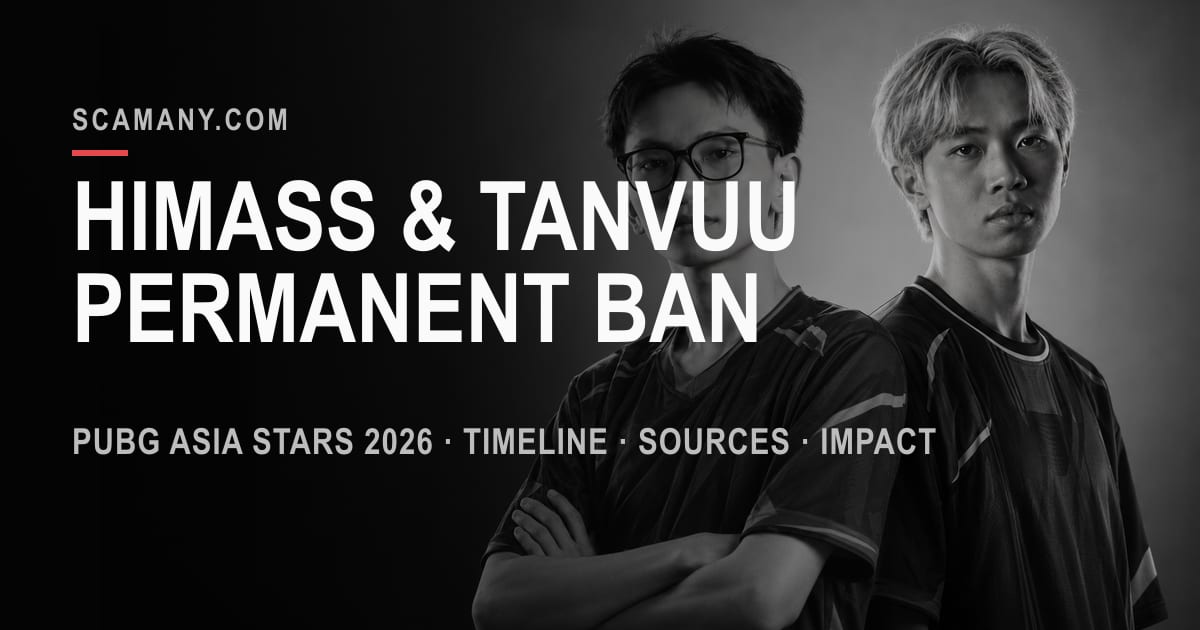
Public debate centres on two players. But a decision like this sends ripples much further: to the publisher, its Korean publishing partner, the players’ organisations, a national team and the streamer-event model itself.
This article works through each layer. In each, sourced facts are separated from analysis of plausible effects. A summary table is on the Impact page.
1. KRAFTON: sanctioning body and self-confessed at fault
Facts:
- KRAFTON imposed the heaviest sanction while publicly admitting at least five categories of operational failure: no mandatory delay, vague rules, incorrect communication before Day 2, slow updates and inconsistency across languages.
- It announced an internal review of the whole process, decision-making included. Per the Vietnamese version, this includes action against the individuals involved under company rules.
Analysis: this dual role creates two-way reputational risk.
- For some viewers, admitting fault signals honesty.
- For others, it highlights a contradiction: if the organizer got so much wrong, why do the players bear the maximum penalty?
How KRAFTON answers that question, if it does, will decide whether the case is remembered as an example of firmness or of shifting blame.
Financial scale: the event’s direct money was a USD 70,000 prize pool plus production costs. That is small next to the risk to the official circuit of PNC, PGS and PGC, which depends on audiences and sponsors trusting its fairness. See the finance analysis.
2. Kakao Games and the Korean market
Facts:
- In Korea, notices were reposted by Kakao PUBG, marked as “content shared by KRAFTON”.
- Korea’s team did not play Day 2. KRAFTON admitted calling the Korean side’s planned boycott a “withdrawal”.
Analysis:
- Korea is KRAFTON’s home market. The reaction of Korean streamers and fans, including the Day 2 boycott, was a real source of pressure during the process.
- A publishing model in which notices pass through a partner can slow and distort messaging. That is part of the “inconsistent communication” KRAFTON admitted.
Note: market pressure is sourced context. Whether it influenced the sanction level is a hypothesis. See hypothesis H3.
3. Vietnamese PUBG esports and PNC
Facts:
- The ban covers PNC, the national-team event.
- Both Himass and TanVuu were on Vietnam’s PNC 2025 title roster. Per PUBG Esports, Himass was tournament MVP and TanVuu led PNC 2025 in total kills.
Analysis:
- If the ban stands, Vietnam loses two pillars of its most recent title-winning roster. That is a direct competitive hit to a region at its peak.
- For Vietnamese audiences, the two players are major draws. Interest in domestic PUBG esports could move either way: down because stars are lost, or up in the short term because of the controversy.
4. The players’ organisations
Facts: Himass plays for Anyone’s Legend. TanVuu is with The Expendables, and his organisation GAM × TE has publicly objected to the sanction.
Analysis:
- Both teams must replace a player mid-season.
- Sponsorship value tied to the players’ image may be affected.
- For GAM × TE, public opposition is a calculated risk: it defends its player but sets the organisation against the publisher that runs the events it competes in.
5. The “streamers + pros” model and UGC events
Facts:
- KRAFTON explained that Asia Stars was built around UGC modes and live streamer-viewer interaction, which is why the delay was optional.
- The 11 September notice said some Playgrounds modes would be added to the game in October.
- After the case, KRAFTON promised clear rules on delay, outside information, monitoring and sanctions for similar events.
Analysis:
- This is probably the most important long-term effect. Streamer events are attractive because they are live, and a mandatory delay dilutes that.
- Publishers will have to choose between interaction and fairness controls, or redesign to get both. Options include separating a delayed competition feed from an interactive stream, or choosing modes that depend less on positional information.
- Without a solution, UGC promotional events like this may be run more cautiously.
Indicators to watch
| Indicator | Question it answers |
|---|---|
| Vietnam’s PNC 2026 roster | Actual competitive impact |
| Rules of PUBG’s next streamer event | How KRAFTON fixed the design |
| Published internal review results | Publisher accountability |
| Outcome of the players’ response process | Whether the sanction changes |
| Both teams’ roster announcements | Impact on the teams |
Conclusion
The biggest impact is not the USD 70,000 prize pool. It lies in three places:
- Trust in KRAFTON’s disciplinary system.
- The competitiveness of Vietnamese PUBG esports.
- The future of the streamer-event model.
All three depend on how transparent the next phase is, namely the response process and the internal review.